
Most conversations about semaglutide and tirzepatide start and end with a number on a scale. That’s understandable — weight loss is the headline result, and it’s the easiest thing to measure and market. But for many patients and prescribers, the more meaningful story is happening elsewhere: in blood pressure readings, cholesterol panels, blood sugar markers, sleep studies, and joint function. This piece steps back from the scale to look at the broader health picture — what the research actually shows about these medications’ effects beyond weight, and why that fuller picture matters for how you think about starting and staying on a program.
This is educational content summarizing general research findings, not a substitute for a conversation with your own physician about your specific health risks and how these medications might factor into managing them.
Why Weight Loss Alone Undersells What’s Happening
Excess weight, particularly around the abdomen, doesn’t just affect how the body looks — it’s mechanistically linked to a wide range of downstream health issues: insulin resistance, elevated blood pressure, unfavorable cholesterol patterns, increased strain on joints, and a higher burden on the cardiovascular system, among others. When these medications produce meaningful, sustained weight loss, many of these related issues improve alongside it — sometimes to a degree that goes beyond what would be predicted from weight change alone, suggesting these medications may have some direct metabolic effects independent of weight loss itself.
This is part of why some of these medications carry approvals or research support that extends well past weight management alone — the health impact of the underlying mechanism appears to reach further than just the number on the scale.
Cardiovascular Health
What the Research Shows
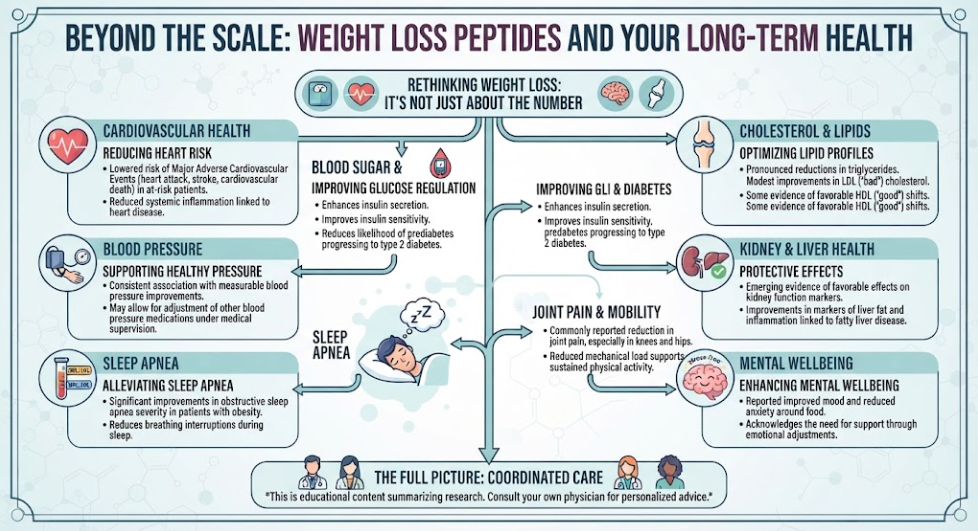
Cardiovascular outcomes have become one of the most closely studied areas for these medications, and the results have been significant enough to shift how they’re viewed clinically. Large-scale cardiovascular outcomes trials involving semaglutide in patients with existing cardiovascular disease and either obesity or overweight have shown a meaningful reduction in the risk of major adverse cardiovascular events — a composite measure typically including heart attack, stroke, and cardiovascular death — compared to placebo. This kind of trial result is a significant marker in medicine, since it demonstrates an effect on hard clinical outcomes, not just an intermediate measure like weight or blood pressure.

How It Likely Works
Several mechanisms appear to contribute to this cardiovascular benefit, and current research suggests it’s likely a combination of factors rather than any single pathway:
- Reduced strain on the heart as excess weight decreases, lowering the overall cardiovascular workload
- Improved blood pressure, which directly reduces cardiovascular risk over time
- Better lipid profiles, particularly reductions in triglycerides and modest improvements in cholesterol patterns
- Reduced systemic inflammation, which is increasingly understood to play a role in cardiovascular disease progression
- Possible direct effects on blood vessel function and heart tissue, an area still being actively researched
What This Means Practically
For patients with existing cardiovascular risk factors or disease, this body of research has meaningfully shifted how these medications are viewed – not simply as a weight management tool, but as part of a broader cardiovascular risk reduction strategy. This is exactly the kind of factor a prescriber will weigh heavily when discussing whether one of these medications makes sense for your specific health profile, particularly if you have a personal or family history of heart disease.
Blood Sugar and Diabetes Risk
The Original Use Case, Still Highly Relevant
It’s easy to forget, amid all the weight-loss-focused conversation, that these medications were originally developed and approved for type 2 diabetes management. Their effect on blood sugar regulation remains one of their best-established benefits, working through several complementary mechanisms:
- Enhancing insulin secretion in response to elevated blood sugar
- Suppressing glucagon, a hormone that raises blood sugar levels
- Slowing gastric emptying, which moderates the speed of post-meal blood sugar spikes
- Improving insulin sensitivity, particularly with tirzepatide’s added GIP receptor activity
Beyond Existing Diabetes: Prevention
For patients who don’t yet have diabetes but are at elevated risk — often due to excess weight, insulin resistance, or a condition called prediabetes — meaningful weight loss combined with these direct effects on insulin and glucose regulation has been associated with a reduced likelihood of progressing to full type 2 diabetes. This preventive angle is a significant part of the broader health case for these medications, since type 2 diabetes carries its own long-term cascade of complications affecting the heart, kidneys, eyes, and nerves.
What This Means Practically
For patients with prediabetes, insulin resistance, or existing type 2 diabetes, blood sugar improvement is often one of the most immediately measurable benefits of treatment, frequently showing up in lab work well before dramatic weight changes are visible. This is part of why regular lab monitoring throughout treatment matters — it captures meaningful progress that the scale alone doesn’t show.
Blood Pressure
Elevated blood pressure is closely tied to excess weight, and meaningful weight loss on these medications is consistently associated with measurable improvements in blood pressure readings. This effect appears to be driven both by weight loss itself — less mass for the cardiovascular system to support — and potentially by more direct effects on blood vessel function and fluid balance.
For patients on blood pressure medication when starting treatment, this improvement can sometimes be significant enough that a prescriber needs to adjust or reduce other blood pressure medications over time to avoid readings dropping too low. This is a good example of why medical supervision throughout treatment matters beyond just managing the peptide medication itself – your entire medication regimen may need coordinated adjustment as your health improves.
Cholesterol and Lipid Profiles
Research on these medications has generally shown favorable shifts in lipid panels, including:
- Reductions in triglycerides, often one of the more pronounced changes
- Modest improvements in LDL (“bad”) cholesterol in many patients
- Some evidence of favorable shifts in HDL (“good”) cholesterol, though this effect tends to be less pronounced than the changes in triglycerides and LDL
These changes contribute meaningfully to the overall cardiovascular risk reduction discussed earlier, and they’re part of why ongoing lipid panel monitoring is a standard part of a well-managed program — it’s one of the clearer, most objective ways to track health improvement beyond weight alone.
Sleep Apnea
One of the more significant and clinically meaningful findings in recent research involves obstructive sleep apnea, a condition strongly linked to excess weight, particularly around the neck and upper airway. Dedicated clinical trials evaluating tirzepatide specifically in patients with obesity and moderate-to-severe obstructive sleep apnea have shown substantial improvements in apnea severity, with many patients experiencing significant reductions in the number of breathing interruptions during sleep.
Why This Matters Beyond Sleep Quality
Sleep apnea isn’t just a quality-of-life issue — it’s associated with elevated cardiovascular risk, daytime fatigue with real safety implications (including drowsy driving), and impaired metabolic health, creating something of a vicious cycle with weight and blood sugar regulation. Improvement in sleep apnea severity can therefore have ripple effects across several other areas of health simultaneously, and for patients using a CPAP machine or other sleep apnea treatment, this is an important area to discuss with both their prescriber and their sleep medicine provider, since treatment needs may shift as symptoms improve.
Joint Pain and Mobility
While less studied in formal clinical trials than some of the other areas covered here, joint pain — particularly in weight-bearing joints like the knees and hips — is one of the most commonly reported quality-of-life improvements among patients losing significant weight through these medications. The mechanism here is fairly intuitive: every pound of weight lost reduces the mechanical load on weight-bearing joints, and for patients with osteoarthritis or general joint strain, this reduced load can translate into meaningfully less pain and improved mobility.
This improvement often has a compounding effect on the rest of a treatment program: reduced joint pain makes physical activity more comfortable and sustainable, which in turn supports muscle preservation, cardiovascular health, and continued weight management — creating a positive cycle that reinforces the other benefits described throughout this piece.
Kidney Health
Emerging research has also examined the effects of these medications on kidney function, particularly in patients with type 2 diabetes, where kidney complications are a well-recognized long-term risk. Some studies have shown favorable effects on markers of kidney function and a reduced risk of kidney disease progression in at-risk patients, thought to result from a combination of improved blood sugar control, reduced blood pressure, and possibly some more direct protective effects on kidney tissue. This is an active and evolving area of research, and patients with existing kidney concerns should discuss this specifically with their prescriber, since it may factor into treatment decisions.
Liver Health
Excess weight and insulin resistance are closely linked to fatty liver disease, a condition that’s become increasingly common and can progress to more serious liver damage if unaddressed. Research on these medications has shown improvements in markers of liver fat and, in some studies, improvements in liver inflammation among patients with fatty liver disease. This represents another area where the metabolic effects of treatment appear to extend benefits well beyond weight alone.
Mental and Emotional Wellbeing
This area is less formally studied than the physical health markers above, but it’s frequently reported by patients and worth mentioning honestly, including its complexity. Many patients report improved mood, reduced anxiety around food and eating, and a general sense of relief tied to reduced preoccupation with hunger and food-related decision-making throughout the day. At the same time, this is a genuinely individual experience — some patients navigate a complicated emotional adjustment as their relationship with food and their body changes rapidly, and this is an area where support from a mental health professional, alongside the medical team, can be genuinely valuable. Neither the positive nor the more complicated emotional experiences should be dismissed; both are real and worth discussing openly with your care team as they arise.
Putting the Full Picture Together
When these individual areas of benefit are considered together, a clearer picture emerges of why these medications have generated so much interest in the medical community beyond their headline weight-loss effect:
- Cardiovascular risk reduction, supported by outcomes trials showing fewer major cardiac events
- Blood sugar improvement and diabetes prevention, building on the original diabetes indication
- Blood pressure reduction, easing cardiovascular strain
- Favorable lipid changes, further supporting cardiovascular health
- Meaningful improvement in sleep apnea severity, with downstream benefits for safety and metabolic health
- Reduced joint pain and improved mobility, supporting sustained physical activity
- Emerging evidence of kidney and liver protective effects, particularly relevant for at-risk patients
- Reported improvements in overall wellbeing, alongside a need for real support through the emotional adjustment involved
None of these benefits are guaranteed for every individual, and the degree of improvement varies based on starting health status, weight loss achieved, medication and dose, and individual physiology. But taken together, they represent a genuinely different way of thinking about these medications than “weight loss drug” alone captures.
What This Means for How You Think About Treatment
If you’re evaluating whether a peptide weight loss program is right for you, it’s worth having a broader conversation with your prescriber than simply “how much weight will I lose.” Useful questions to bring to that conversation include:
- Given my specific health history, which of these secondary benefits are most relevant to me?
- What baseline labs and measurements should we track beyond weight, so we can see the fuller picture of progress?
- How might this treatment interact with medications I’m already taking for blood pressure, cholesterol, or blood sugar?
- If I have sleep apnea, joint pain, or other weight-related conditions, how should those specialists be looped into this process?
This kind of conversation tends to produce a more complete treatment plan — one that tracks and celebrates progress across multiple health markers, not just the number on a scale, and one where your broader care team is coordinated around the changes happening in your body as treatment progresses.
The Bottom Line
The scale captures one part of what’s happening on a peptide weight loss program, but it’s far from the whole story. Research increasingly shows that these medications influence cardiovascular risk, blood sugar regulation, blood pressure, cholesterol, sleep apnea, joint health, and potentially kidney and liver function — a breadth of effect that reflects the underlying metabolic mechanisms at work, not just the visible result of weight loss. Understanding this fuller picture doesn’t just make for a more complete view of the medication — it can meaningfully change how you and your care team approach monitoring, goal-setting, and coordinating treatment with the rest of your health picture. The number on the scale matters, but for many patients, it turns out to be the least interesting part of the story.
Leave a Reply