
The surge in demand for weight loss peptides like semaglutide and tirzepatide has created a genuine problem: supply hasn’t kept pace, and a parallel market has grown up around it — one filled with sellers who are more interested in filling that gap than in patient safety. Some of what’s marketed as “peptide therapy” today comes from legitimate telehealth platforms and licensed clinics doing this well. Some of it comes from websites selling vials labeled “research use only” to anyone with a credit card. Telling the difference matters, because the wrong choice here isn’t just a bad customer experience – it can mean unregulated products, incorrect dosing, and a complete absence of the medical oversight these medications are designed to require. This guide walks through exactly what to look for, and what to avoid, when evaluating a peptide provider.
Why This Distinction Matters So Much
Peptide medications like semaglutide and tirzepatide are not over-the-counter supplements. They’re prescription drugs, regulated for good reason: they carry real contraindications, require individualized dosing that changes over time, and can cause serious side effects in some patients. The entire safety model behind these medications assumes a licensed prescriber is involved – someone who reviews your health history, orders lab work, adjusts your dose based on how you respond, and is available if something goes wrong.
When that oversight is missing, every part of that safety model disappears. You lose the screening that would catch a contraindication like a personal or family history of certain thyroid cancers. You lose the individualized dosing that accounts for your specific health profile. You lose the ability to have side effects properly evaluated instead of guessed at. And with unregulated sourcing, you may also lose any real assurance that what’s in the vial is what the label says it is, at the purity and concentration it claims.
None of this is meant to be alarmist for its own sake — it’s simply the reason the red flags below are worth taking seriously rather than treating as minor inconveniences to work around.
Red Flag #1: No Real Medical Evaluation
This is the single biggest warning sign, and it should be disqualifying on its own. A legitimate provider will always require:
- A detailed medical history, including past conditions, surgeries, and family history
- A review of current medications and supplements
- Some form of lab work, either through your own records or ordered directly, typically including metabolic and thyroid panels
- A conversation — via video, phone, or in person — with an actual licensed prescriber, not just a form to fill out
If a website lets you “get started” by simply selecting a product, entering a shipping address, and paying, with no meaningful medical review in between, that’s not a medical provider — it’s a retailer, regardless of how clinical the branding looks. A short intake questionnaire with no follow-up conversation and no lab requirement is a version of this same problem dressed up to look more legitimate than it is.
Red Flag #2: No Licensed Prescriber Behind the Product
Every legitimate source of these medications has an actual licensed prescriber — a physician, nurse practitioner, or physician assistant — who reviews your case and writes the prescription. This person should be:
- Identifiable, often with their name, credentials, and license information available
- Licensed in your state (prescribers generally need to be licensed in the state where the patient is located, particularly for telehealth)
- Someone you can reasonably reach or be connected to if you have questions or concerns
If a site is vague about who, exactly, is approving your treatment — or if the language dances around it with phrases designed to sound clinical without ever naming a person or license — that vagueness is itself a signal. Legitimate providers are generally proud to name their medical team, not evasive about it.

Red Flag #3: Products Labeled “Not for Human Consumption” or “Research Use Only”
This is one of the clearest and most important red flags to know, because it’s often hiding in plain sight. A significant portion of the gray-market peptide industry operates by selling compounds labeled for “research purposes only” or “not for human consumption” — a labeling choice that exists specifically to sidestep the regulatory requirements that apply to actual pharmaceutical products.
In practice, these labels mean the product has not gone through the quality control, purity testing, and manufacturing oversight required of an actual medication. There’s no guarantee of what’s actually in the vial, at what concentration, or whether it’s been handled and stored properly. Some of these products have been found in independent testing to contain incorrect concentrations, contaminants, or, in some cases, different substances entirely than what was advertised. If a peptide seller uses this kind of labeling, it should be treated as a hard stop, regardless of how professional the rest of the website looks.
Red Flag #4: No Requirement for Lab Work
Baseline lab work isn’t a bureaucratic formality — it’s how a prescriber confirms you’re actually a safe candidate for the medication and establishes a reference point for monitoring you over time. Relevant labs typically include a metabolic panel, thyroid function tests, HbA1c, and a lipid panel, though the exact panel can vary based on your history.
A provider who never asks for labs — either your existing results or a fresh panel — has no way of knowing whether you have a condition that would make the medication inappropriate or dangerous, and no way to track how your body is responding over time. Ongoing lab work at intervals during treatment is also part of responsible long-term management, so a provider who does one-time labs (if any) and never revisits them is offering an incomplete version of care.
Red Flag #5: No Ongoing Monitoring or Follow-Up
Weight loss medications like these aren’t a “prescribe once and done” treatment. Doses are typically increased gradually over weeks to months, and that titration schedule needs to be managed by a prescriber based on how you’re actually responding — not on a fixed timeline handed to you at checkout. A legitimate program includes:
- Scheduled follow-up appointments, especially in the early months
- A clear way to report side effects and get a timely response
- Dose adjustments based on your individual progress and tolerance, not a one-size-fits-all schedule
- An ongoing relationship, not a single transaction
If your only contact with a “provider” is an automated refill reminder, and there’s no mechanism to flag side effects or ask questions to an actual clinician, that’s not ongoing medical care — it’s a subscription box.
Red Flag #6: Vague, Inconsistent, or Missing Dosing Guidance
Because dosing on these medications is individualized and increases gradually, a legitimate provider will give you a specific, personalized schedule and clear instructions, along with a way to ask questions if anything is unclear. Warning signs here include:
- Generic dosing information that doesn’t seem to account for your specific situation
- Pressure to increase your dose faster than a typical titration schedule, often framed around getting faster results
- No clear channel to ask a real clinician about dosing questions or concerns
- Instructions that seem to originate from a shipping insert rather than an actual conversation with a prescriber
Red Flag #7: Pressure Tactics and Unrealistic Promises
Be cautious of any provider whose marketing leans heavily on urgency and dramatic claims rather than clinical substance:
- Countdown timers, “limited stock” messaging, or heavy discounting designed to rush a purchase decision
- Promises of guaranteed weight loss numbers or timelines
- Claims that sidestep or minimize legitimate side effects and risks
- Testimonials or before-and-after photos with no verifiable connection to actual patients, or results presented as typical when they’re clearly outliers
Legitimate medical providers are generally more measured in their marketing, precisely because they’re bound by both clinical ethics and, often, advertising regulations that gray-market sellers simply ignore.
Red Flag #8: No Clear Path for Problems or Emergencies
Ask yourself: if something went wrong — a severe reaction, a question about a symptom, a need to pause treatment — is there an actual, responsive way to reach a clinician? Legitimate providers make this clear, typically with:
- A stated process for urgent concerns
- Contact information for a real clinical team, not just a general customer service inbox
- Guidance on when to seek emergency care versus contacting the provider directly
If this information is absent, unclear, or buried, it’s worth asking directly before starting treatment, and treating a non-answer as its own red flag.
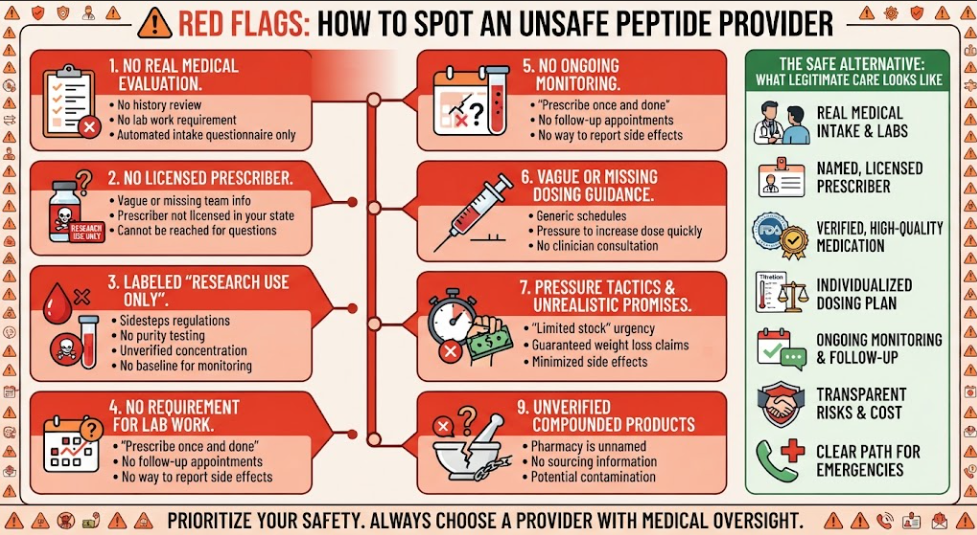
Red Flag #9: Compounded Products From Unverified Pharmacies
Compounded versions of these medications exist and can be legitimate when produced by properly licensed, FDA-registered compounding pharmacies, particularly during periods of shortage of the brand-name product. However, compounding has also become a common avenue for lower-quality or improperly sourced products. Signs of a legitimate compounding arrangement include:
- The pharmacy is named and verifiable, with appropriate state and federal registration
- The provider can explain why compounding is being used (commonly, shortage of the brand-name product) rather than presenting it as simply a cheaper default option
- Clear sourcing and quality information is available on request
If a provider is vague about which pharmacy is compounding the product, or resistant to answering direct questions about sourcing, that reluctance is worth taking seriously.
What Legitimate Care Actually Looks Like
It’s worth painting the positive picture as clearly as the warning signs, so the contrast is obvious. A trustworthy peptide provider typically offers:
- A real medical intake, including history review and lab work
- A named, licensed prescriber who reviews your case individually
- FDA-approved medication, or compounded product from a verifiable, properly licensed pharmacy, with clear sourcing information available
- An individualized dosing plan with a clear titration schedule
- Scheduled follow-ups and a real channel for questions or side effect reporting
- Transparent, non-pressured communication about risks, realistic expectations, and cost
- Clear guidance on what to do in case of a concerning symptom or emergency
If a provider checks these boxes, the relative convenience of telehealth versus an in-person clinic becomes mostly a matter of personal preference — both can represent legitimate, safe care when the fundamentals above are in place.
Questions Worth Asking Before You Start
If you’re evaluating a provider and it’s not immediately obvious whether they meet the bar above, a short list of direct questions can clarify things quickly:
- Who is the licensed prescriber reviewing my case, and are they licensed in my state?
- What does the medical evaluation process involve, and is lab work required?
- Is the product FDA-approved, or compounded — and if compounded, by which pharmacy?
- What does the dosing and titration schedule look like, and who manages adjustments?
- How do I reach a clinician if I have questions or side effects?
- What follow-up or monitoring is built into the program?
A legitimate provider should be able to answer all of these clearly and without hesitation. Hesitation, vagueness, or redirection on any of them is worth treating as a genuine warning sign rather than a minor inconvenience.
The Bottom Line
The peptide weight-loss space has real, effective, well-studied treatment options — and it also has a substantial gray market willing to sell products without the oversight that makes those treatments safe in the first place. The difference usually isn’t hard to spot once you know what to look for: real medical evaluation, a named and licensed prescriber, properly sourced medication, individualized dosing, and ongoing follow-up are the non-negotiables. A provider missing more than one or two of these isn’t offering a slightly less convenient version of legitimate care — they’re offering something categorically different, and often genuinely risky. Taking the time to evaluate a provider against this list before starting treatment is one of the most important steps in the entire process, arguably more important than which specific medication you end up choosing.
Leave a Reply