Few medical developments in recent history have captured public attention quite like the arrival of advanced incretin-based therapies. If you are exploring your health options, you have likely run into the two dominant names in this pharmaceutical revolution: Ozempic and Zepbound.
While casual conversation often lumps them together as simple weight-loss shots, asking your doctor for one over the other requires looking past the cultural hype. They are distinct chemical entities, approved for different primary indications, backed by varying clinical data, and managed entirely differently by health insurance providers.
Navigating this choice requires understanding how they work, how much weight you can realistically expect to drop, and which medication aligns with your specific health blueprint.

The Core Differences: Molecules, Mechanisms, and Approvals
To understand why Ozempic and Zepbound yield different results, you have to look under the molecular hood. Though both are administered as once-weekly subcutaneous injections, they target your endocrine system through distinct pathways.
- Ozempic (semaglutide): Manufactured by Novo Nordisk, Ozempic is a single GLP-1 receptor agonist. It mimics a natural gut hormone that stimulates insulin secretion, suppresses glucagon release, slows down gastric emptying, and signals satiety to the brain.
- FDA Approval: Ozempic is officially indicated for the treatment of type 2 diabetes (to improve glycemic control) and to reduce the risk of major adverse cardiovascular events (like stroke or heart attack) in adults with type 2 diabetes and heart disease. (Note: Novo Nordisk’s high-dose semaglutide product approved specifically for chronic weight management is branded as Wegovy).
- Zepbound (tirzepatide): Manufactured by Eli Lilly, Zepbound is a dual GIP/GLP-1 receptor agonist. By activating both receptors simultaneously, it engages an additional metabolic pathway. GIP works synergistically with GLP-1 to further optimize insulin secretion, enhance how the body handles energy storage, and uniquely target brain regions associated with severe food cravings.
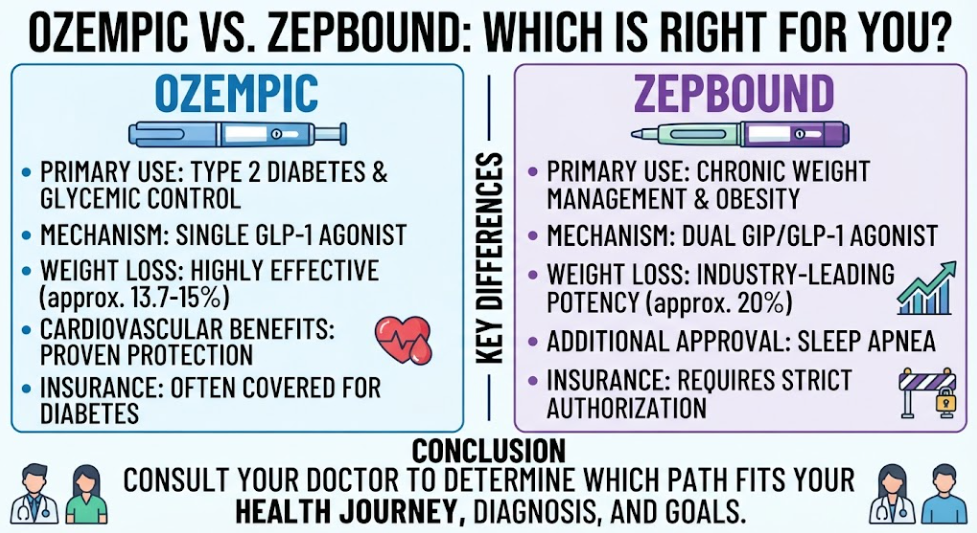
- FDA Approval: Zepbound is officially indicated for chronic weight management in adults with obesity or overweight with at least one weight-related condition. It is also approved to treat moderate-to-severe obstructive sleep apnea in adults with obesity. (Note: The exact same active ingredient, tirzepatide, is marketed under the brand name Mounjaro for type 2 diabetes).
Head-to-Head Efficacy: Weight Loss and Blood Sugar
When patients ask which medication is more effective, they are usually looking at weight-loss outcomes. Clinical trials and comparative research provide clear data on how these medications perform.
- Weight Loss Potential: Clinical trial data demonstrates that the dual-agonist mechanism of Zepbound yields greater biological potency. While semaglutide pathways typically show average total body weight reductions around 13.7% to 15%, tirzepatide clinical trials (such as the landmark SURMOUNT-5 study) showcase average weight loss exceeding 20%, leading to significantly higher comparative performance in head-to-head trials.
- Blood Sugar and Organ Protection: Both drugs are extraordinarily effective at lowering HbA1c in patients with type 2 diabetes. Because Ozempic was engineered explicitly for diabetes management, it boasts robust, long-term cardiovascular and renal outcome trials proving it protects kidneys and lowers the risk of heart attacks and strokes.
Side Effects and Tolerability
Because both medications manipulate the gastrointestinal tract and slow down stomach emptying, they share a very similar side-effect profile.
- Common Gastrointestinal Symptoms: Nausea, vomiting, diarrhea, constipation, and abdominal bloating affect a significant percentage of users. These symptoms are typically most intense during the initial dose-escalation phase and tend to subside as your body adjusts.
- The Titration Schedule: To mitigate severe digestive distress, both drugs require a slow start. You begin at a low introductory dose and gradually step up over several weeks.
- Boxed Warnings: Both medications carry a boxed warning regarding thyroid C-cell tumors observed in animal studies. Neither drug should be used by individuals with a personal or family history of medullary thyroid carcinoma (MTC) or Multiple Endocrine Neoplasia syndrome type 2 (MEN 2).
The Real-World Barrier: Insurance, Cost, and Access
Clinical superiority means little if your insurance carrier refuses to pay for the prescription. This is often where the decision between Ozempic and Zepbound is dictated strictly by policy guidelines:
- The Diagnosis Divide: Insurance companies routinely cover Ozempic if you have an official diagnosis of type 2 diabetes. Conversely, getting coverage for anti-obesity medications like Zepbound historically requires fighting through stringent prior authorization criteria, and many standard health plans outright exclude weight-loss treatments.
- Out-of-Pocket Realities: Without insurance coverage, list prices for both brand-name biologics hover around $900 to $1,000+ per month. Manufacturers offer savings cards and direct-to-consumer self-pay pathways that can reduce these cash prices, but monthly costs remain a major financial commitment.
Summary Matrix: Which Should You Ask For?
- Ask for Ozempic if: your primary health goal is managing type 2 diabetes, securing long-term cardiovascular and kidney protection, and using a medication with extensive long-term safety data in diabetic populations.
- Ask for Zepbound if: Your primary goal is chronic weight management, treating obesity-related complications like obstructive sleep apnea, and you require the highest biological potency available for weight reduction.
The Final Word on Ozempic vs. Zepbound GLP-1 Meds
Choosing between Ozempic and Zepbound ultimately comes down to your primary medical diagnosis, your insurance formulary guidelines, and your personal treatment goals. If you are managing type 2 diabetes, Ozempic remains a premier, highly trusted choice backed by robust organ-protection data.
If your focus is tackling obesity or metabolic weight concerns with maximum potency, Zepbound stands out as the purpose-built, on-label option. Because these decisions carry significant medical and financial implications, a thorough discussion with your physician is essential to determine which path best fits your health journey.
________________________
Sources & References
- American College of Cardiology. “SURMOUNT-5: Greater Loss of Weight, Waist Circumference With Tirzepatide Than Semaglutide.” The New England Journal of Medicine, July 2025.
- Aronne, L. J., et al. “Tirzepatide as Compared with Semaglutide for the Treatment of Obesity (SURMOUNT-5).” The New England Journal of Medicine, 2025.
- Eli Lilly and Company. “Zepbound (tirzepatide) superior to Wegovy (semaglutide) in head-to-head trial showing an average weight loss of 20.2% vs 13.7% (SURMOUNT-5).” Press Release, May 2025.
- U.S. Food and Drug Administration (FDA). Prescribing Information and Approval Guidelines for Ozempic (semaglutide) and Zepbound (tirzepatide).
Leave a Reply