
Stepping into the landscape of modern metabolic therapy can feel like navigating an entirely new medical frontier. If you are exploring prescription options for type two diabetes management or chronic weight control, you will quickly encounter the two dominant forces in the incretin-based therapy market: Mounjaro and Ozempic.
While both medications are administered as once-weekly subcutaneous injections and share similarities in how they influence metabolic health, they operate through distinct chemical structures, activate different cellular pathways, and yield unique clinical results.
The Molecular Foundation: Understanding the Active Ingredients
To truly understand why these two treatments perform differently in clinical settings, we must look at what happens at the cellular level when a dose is administered.
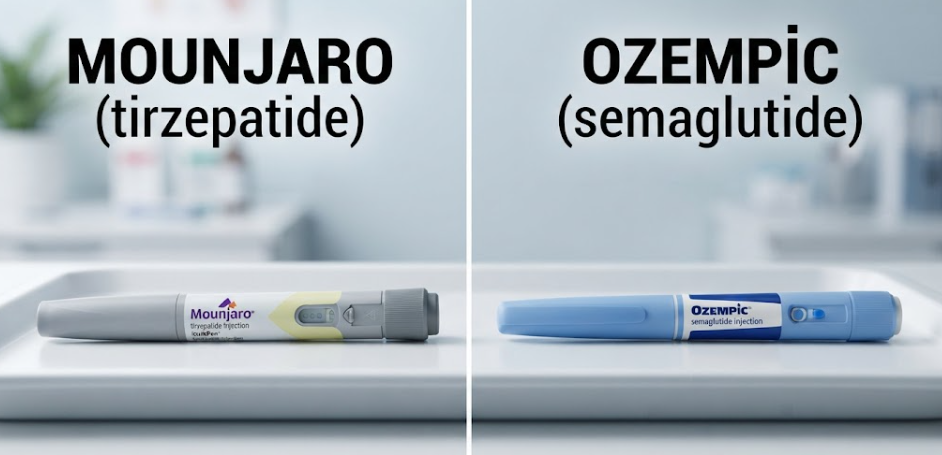
- Ozempic (semaglutide): Manufactured by Novo Nordisk, Ozempic contains semaglutide, which functions as a selective glucagon-like peptide-1 (GLP-1) receptor agonist. It is designed to mimic the natural GLP-1 hormone that your gut releases after eating. By binding to GLP-1 receptors in the pancreas and the central nervous system, it stimulates glucose-dependent insulin secretion, suppresses inappropriate glucagon release, slows gastric emptying, and signals satiety to the brain’s appetite centers.
- Mounjaro (tirzepatide): Manufactured by Eli Lilly, Mounjaro contains tirzepatide, which represents a structural evolution in metabolic science. It acts as a dual glucose-dependent insulinotropic polypeptide (GIP) and GLP-1 receptor co-agonist. By activating both of these incretin hormone receptors simultaneously, Mounjaro engages an additional physiological pathway. The GIP receptor component works synergistically with the GLP-1 component to further optimize insulin sensitivity, enhance lipid metabolism, and provide an even more profound suppression of hunger cues.

The Receptor Advantage
While Ozempic relies exclusively on the single GLP-1 pathway, Mounjaro’s dual-agonist design targets two distinct hormonal systems. Clinical pharmacologists have observed that this dual approach creates an amplified metabolic response, which largely explains the higher efficacy benchmarks seen in comparative clinical trials.
Clinical Trial Data: Head-to-Head and Benchmark Efficacy
When patients and clinicians review these medications, clinical trial data serves as the baseline for expected outcomes. While Ozempic and Mounjaro were originally developed primarily for glycemic control in type two diabetes, their profound impact on weight reduction has driven extensive clinical evaluation.
Comparative Efficacy Overview
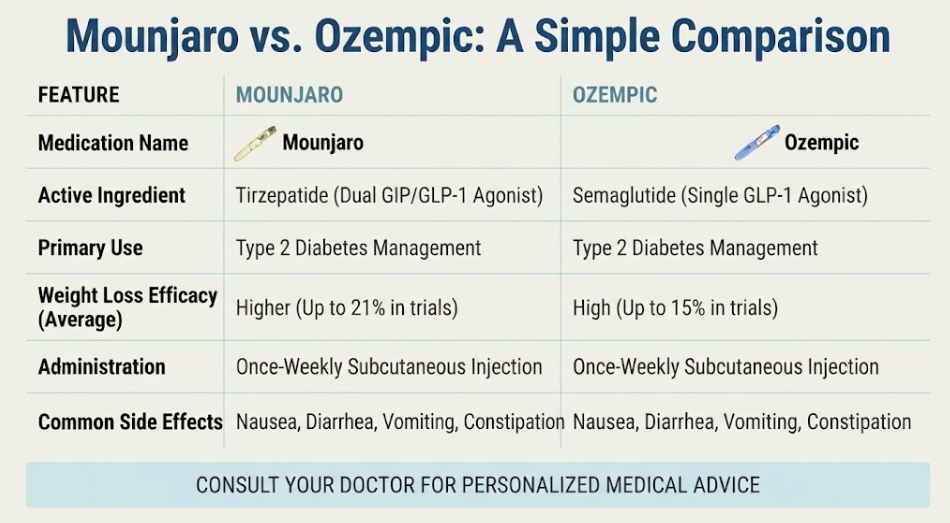
| Clinical Metric | Ozempic (Semaglutide Pathway) | Mounjaro (Tirzepatide Pathway) |
| Active Molecule | Semaglutide | Tirzepatide |
| Receptor Targeting | Single GLP-1 Agonist | Dual GIP/GLP-1 Agonist |
| Average Glycemic Reduction (HbA1c) | $-1.5\%$ to $-1.8\%$ | $-2.0\%$ to $-2.4\%$ |
| Average Body Weight Reduction | $-12\%$ to $-15\%$ | $-15\%$ to $-22\%$ |
| Maximum Studied Dose | $2.0\text{ mg}$ weekly | $15.0\text{ mg}$ weekly |
As illustrated by clinical trials such as the SURPASS program for Mounjaro and the SUSTAIN program for Ozempic, patients utilizing tirzepatide frequently achieve greater reductions in both blood glucose levels and total body weight compared to those on semaglutide.
- Cardiovascular and Organ Protection: Beyond glucose and weight management, Ozempic holds a prominent indication for reducing major adverse cardiovascular events (such as nonfatal stroke, nonfatal myocardial infarction, and cardiovascular death) in adults with type two diabetes and established heart disease. Mounjaro has similarly demonstrated impressive cardiovascular risk reduction markers in its ongoing extensive clinical trials, alongside significant improvements in fatty liver disease markers and metabolic syndrome parameters.
Real-World Case Studies
Clinical trials provide clean statistical averages, but human physiology and daily life introduce complex variables. The following anonymized composite case studies demonstrate how these medications perform in everyday practice.
Case Study: Managing Glycemic Plateaus and Visceral Fat with Mounjaro
- Patient Profile: David, a fifty-four-year-old software engineer diagnosed with type two diabetes, struggling with persistent fatigue, high visceral adiposity, and an unyielding HbA1c of 8.6% despite oral metformin therapy.
- Clinical Journey: David’s endocrinologist recommended transitioning him to Mounjaro, starting at the mandatory introductory dose of 2.5 mg weekly to mitigate gastrointestinal distress. His dosage was systematically titrated upward by 2.5 mg every four weeks until reaching a stable maintenance dose of 10 mg weekly.
- Outcome: Over nine months, David’s HbA1c dropped from 8.6% to 5.7%, bringing his blood sugar into a completely non-diabetic range. Concurrently, he experienced a total body weight reduction of roughly 19%, significantly lowering his blood pressure and eliminating his reliance on prior hypertension medications. His primary side-effect hurdle was mild, transient nausea during the first forty-eight hours following each dose escalation, which he managed successfully by eating smaller portions and increasing ginger tea consumption.
Case Study: Long-Term Cardiovascular Focus and Blood Sugar Stabilization with Ozempic
- Patient Profile: Elena, a sixty-two-year-old accountant with a long-standing history of type two diabetes, mild diabetic nephropathy, and a previous minor cardiac event.
- Clinical Journey: Because Elena’s primary medical vulnerability centered around her cardiovascular history and kidney function preservation, her primary care physician prescribed Ozempic. The decision was heavily influenced by Ozempic’s robust, long-standing cardiovascular safety data and specific renal protection indicators.
- Outcome: Elena titrated slowly up to the 1.0 mg weekly dose. Over twelve months, her HbA1c stabilized comfortably at 6.4%. While her total weight loss was more moderate at approximately 12%, her primary clinical objectives—cardiovascular stabilization and preservation of estimated glomerular filtration rate (eGFR)—were successfully achieved. She reported very mild appetite suppression that allowed her to naturally portion control her meals without feeling deprived.
Tolerability and Side-Effect Management
Because both Mounjaro and Ozempic operate by slowing gastric emptying and interacting with neurological appetite centers, they share a very similar side-effect profile.
- Gastrointestinal Manifestations: The most frequently reported adverse events include nausea, vomiting, diarrhea, constipation, acid reflux, and early satiety. These symptoms are dose-dependent and typically peak during the initial weeks of treatment or immediately following a dose increase.
- The Necessity of Gradual Titration: To prevent severe gastrointestinal intolerance, both medications require a strict, gradual titration schedule. Patients begin at low introductory doses and slowly step upward over months.
- Boxed Warnings: Both drugs carry an identical FDA boxed warning regarding the risk of thyroid C-cell tumors, based on rodent studies. Neither medication should be prescribed to individuals with a personal or family history of medullary thyroid carcinoma (MTC) or Multiple Endocrine Neoplasia syndrome type 2 (MEN 2). Furthermore, both carry risks of acute pancreatitis, gallbladder disease, and acute kidney injury secondary to severe dehydration from gastrointestinal illness.
Cost, Insurance Formularies, and Access Hurdles
For many patients, the ultimate deciding factor between Mounjaro and Ozempic is not clinical preference, but rather insurance coverage and out-of-pocket affordability.
- Insurance Formulary Dynamics: Insurance companies maintain strict prior authorization criteria. Ozempic is typically covered smoothly for patients with an established diagnosis of type two diabetes. Mounjaro faces similar insurance backing for type two diabetes, though off-label coverage for weight management (or coverage for its weight-loss specific brand counterpart, Zepbound) involves complex tier exceptions and steep prior authorization barriers.
- Out-of-Pocket Realities: Without insurance coverage, retail list prices for both medications routinely exceed $900 to $1,000 per month. Manufacturer savings cards, commercial copay assistance programs, and patient assistance foundations can drastically lower these expenses for eligible commercial insurance policyholders, though Medicare and Medicaid beneficiaries are legally excluded from using manufacturer savings coupons.
Frequently Asked Questions About These Meds
What is the primary difference between Mounjaro and Ozempic?
The primary difference lies in their molecular design. Ozempic contains semaglutide, which is a single GLP-1 receptor agonist. Mounjaro contains tirzepatide, which is a dual GIP and GLP-1 receptor co-agonist, engaging two distinct metabolic pathways to drive higher efficacy in blood sugar control and weight loss.
Which medication provides faster weight loss results?
Clinical trials directly comparing these drug classes indicate that tirzepatide (Mounjaro) generally yields higher average percentage weight loss and greater absolute blood sugar reductions compared to semaglutide (Ozempic), largely due to its dual-agonist mechanism.
Can I switch directly from Ozempic to Mounjaro if my blood sugar is not well controlled?
Yes, but it must be done under direct medical supervision. Because they have different potencies and receptor profiles, your physician will typically stop Ozempic and start you at the lowest introductory dose of Mounjaro to prevent severe gastrointestinal side effects.
How quickly will I notice changes in my blood sugar or appetite?
Most patients notice a significant dampening of appetite and a reduction in food noise within twenty-four to seventy-two hours of their very first injection. Measurable improvements in fasting blood glucose typically appear within the first week, while HbA1c reductions normalize over a three-to-six-month evaluation window.
Do I need to take these injections indefinitely?
Both type two diabetes and chronic obesity are recognized by medical boards as chronic, relapsing conditions. Clinical data demonstrates that when patients discontinue these therapies, a significant portion of lost weight—and elevated blood glucose levels—tends to return over time. Long-term management strategies must be discussed with a doctor.
What should I do if I miss a scheduled weekly dose?
If you miss a dose, take it as soon as possible within four days (ninety-six hours) of the missed injection day. If more than four days have passed, skip the missed dose entirely and resume your normal schedule on your regular injection day. Never take a double dose to make up for a missed one.
Can I drink alcohol while taking these medications?
Alcohol is not strictly forbidden, but it requires caution. Both drugs slow down stomach emptying and influence blood sugar regulation. Alcohol can intensify common side effects like severe nausea, acid reflux, and systemic dehydration. Moderation is strongly advised.
Will these medications cause muscle loss alongside fat?
Any rapid weight reduction protocol can result in some loss of lean muscle mass alongside adipose tissue. To combat this, healthcare providers strongly recommend pairing these treatments with adequate daily protein consumption and regular progressive resistance training exercises.
Are compounded peptide versions of these medications safe?
Compounded semaglutide or tirzepatide formulas offered by compounding pharmacies are chemically distinct from FDA-approved brand-name auto-injectors and are not evaluated by the FDA for sterility, potency, or purity in the same standardized manner. Always consult a licensed physician regarding sourcing safety.
Which medication is ultimately better for a newly diagnosed patient?
There is no single “best” option. If your primary focus is established cardiovascular risk reduction with decades of long-term safety data, Ozempic is a premier choice. If your clinical priority is achieving the absolute highest level of glycemic control and weight reduction, Mounjaro holds a distinct statistical advantage.
Summary Matrix for Clinical Decision-Making
- Choose Ozempic if: You require proven long-term cardiovascular risk reduction, your insurance formulary easily approves it for type two diabetes, or you prefer a medication with a longer real-world safety tracking history.
- Choose Mounjaro if: Maximizing glycemic control and achieving the highest possible percentage of weight loss are your primary therapeutic objectives, and your insurance supports dual-agonist therapy.
The Final Word on Mounjaro VS Ozempic
Choosing between Mounjaro and Ozempic requires a careful balancing act between biological potency, individual health goals, and insurance accessibility. While Mounjaro demonstrates superior statistical efficacy in clinical trials through its dual-agonist mechanism, Ozempic offers an extensive real-world safety track record and robust cardiovascular outcome data.
Because these medications fundamentally alter endocrine pathways and metabolic processing, an open, detailed dialogue with your physician or endocrinologist remains the absolute best path toward selecting the right therapy for your long-term health journey.
________________________
Sources & References
- Jastreboff, A. M., et al. “Tirzepatide Once Weekly for the Treatment of Obesity.” The New England Journal of Medicine, 2022.
- Frías, J. P., et al. “Tirzepatide versus Semaglutide Once Weekly in Patients with Type 2 Diabetes.” The Lancet, 2021.
- Marso, S. P., et al. “Semaglutide and Cardiovascular Outcomes in Patients with Type 2 Diabetes.” The New England Journal of Medicine, 2016.
- American Diabetes Association. “Standards of Care in Diabetes—2024.” Diabetes Care, 2024.
- Eli Lilly and Company. “Mounjaro Prescribing Information and Clinical Pharmacology.” FDA Package Insert, 2023.
- Novo Nordisk. “Ozempic Prescribing Information and Mechanism of Action.” FDA Package Insert, 2023.
Leave a Reply