Starting a peptide weight loss medication changes something most diets never touch: your actual hunger signals. Where traditional dieting asks you to eat less while your appetite stays the same — a recipe for constant willpower battles — peptide medications like semaglutide and tirzepatide quiet the hunger signal itself. That’s a powerful advantage, but it creates a nutrition challenge that’s rarely discussed in detail: when you’re simply not that hungry, how do you make sure what little you do eat actually meets your body’s needs? This guide covers exactly that — how to structure meals, what to prioritize, and how to avoid the most common nutritional pitfalls of eating on a peptide program.
This is general nutrition guidance, not a substitute for personalized advice from your prescriber or a registered dietitian, who can account for your specific labs, health history, and goals.
Why Eating “Well” Matters More on This Kind of Program
On a typical diet, eating less of everything usually still means eating a reasonable volume of food across the day, which naturally spreads nutrients out. On a peptide program, appetite suppression can be strong enough that total food volume drops significantly — sometimes to a fraction of what someone used to eat. That means there’s much less room for nutritional slack. Every meal has to work harder, because there are fewer meals and less food overall to get everything your body needs.
This matters for a few specific reasons:
- Muscle preservation. When calorie intake drops significantly, your body will pull energy from both fat and muscle unless you’re deliberately protecting muscle tissue through adequate protein and resistance training. Losing muscle alongside fat undermines both your metabolism and your long-term results.
- Micronutrient adequacy. Eating less food, especially if it skews toward the same few “safe” foods that don’t trigger nausea, can create gaps in vitamins and minerals over time.
- Digestive comfort. These medications slow gastric emptying, so what and how you eat has a direct effect on whether you feel nauseated, bloated, or fine after a meal.
- Sustainable habits. The eating pattern you build in the first few months tends to become your default going forward, so it’s worth building one that’s nutritionally sound rather than one built entirely around avoiding discomfort.
The Core Principle: Nutrient Density Over Volume
The single most useful mental shift for eating on a peptide program is this: since you’re eating less, every bite needs to count more. That means favoring foods that pack meaningful nutrition into a small volume, rather than foods that are filling but nutritionally thin.
In practice, this means leaning toward:
- Lean proteins (chicken, fish, eggs, Greek yogurt, tofu, legumes)
- Colorful vegetables, which deliver a lot of micronutrients for relatively few calories
- Healthy fats in moderate amounts (avocado, olive oil, nuts) for satiety and nutrient absorption
- Whole, minimally processed carbohydrates (fruit, whole grains, starchy vegetables) rather than refined ones
And leaning away from — not necessarily eliminating, but not prioritizing — foods that take up appetite “space” without much nutritional payoff: sugary drinks, refined snack foods, and large portions of low-nutrient carbohydrates.

Protein: The Non-Negotiable Priority
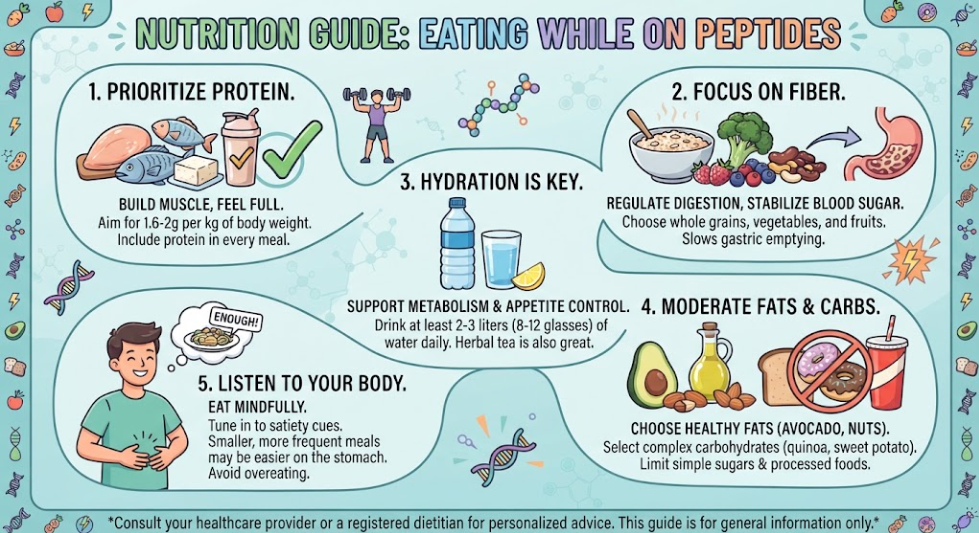
If there’s one nutrient to build your entire eating pattern around while on a peptide program, it’s protein. Adequate protein intake is the single most important dietary factor in preserving muscle mass during medication-assisted weight loss, and it also happens to support the satiety and fullness that make the program easier to stick with.
Why Protein Matters So Much Here
Muscle tissue is metabolically active — it’s part of what keeps your resting metabolism higher, supports strength and mobility, and helps regulate blood sugar. When you lose weight quickly without enough protein, a disproportionate share of that loss can come from muscle rather than fat, which undermines the very outcome you’re working toward. Since appetite suppression on these medications can make it genuinely difficult to eat enough protein, this requires more intention than it typically would on a normal diet.
Practical Ways to Prioritize Protein
- Eat protein first at each meal, before other foods, so you get it in even if you fill up quickly
- Choose protein-forward foods by default — eggs instead of cereal, Greek yogurt instead of regular yogurt, a protein shake when solid food feels unappealing
- Spread protein across the day rather than trying to get it all in one meal, since appetite may only allow for small amounts at a time
- Keep quick, low-effort protein options on hand — hard-boiled eggs, cottage cheese, canned tuna or salmon, protein shakes — for moments when appetite is low and cooking feels like too much
- Work with your care team on a specific target, since exact protein needs vary based on your weight, activity level, and goals, and a dietitian or prescriber can help you land on a number that fits your situation
Structuring Meals Around Reduced Appetite
Smaller, More Frequent Meals
Because gastric emptying slows down on these medications, large meals can sit heavily and trigger discomfort or nausea. Many people find that three or four smaller meals — or a mix of small meals and simple snacks — work better than the traditional three-square-meals pattern. This isn’t a strict rule, but it’s worth experimenting with if large meals feel uncomfortable.
Eating Slowly and Mindfully
Fullness signals tend to arrive faster and more intensely on these medications than people are used to. Eating quickly can mean you don’t notice fullness until you’ve already overeaten — which, on a slowed digestive system, tends to cause more discomfort than it would otherwise. Slowing down, chewing thoroughly, and pausing partway through a meal to check in with your hunger level can make a real difference in comfort.
Not Skipping Meals Entirely
It can be tempting, when appetite drops significantly, to simply not eat for long stretches. But skipping meals altogether — rather than eating smaller ones — tends to backfire in a few ways: it makes it harder to hit protein and nutrient targets for the day, it can lead to low energy, and for some people it leads to an eventual larger, less comfortable meal once hunger does show up. Aiming for small, regular meals — even when you don’t feel hungry — tends to work better than an irregular, skip-and-catch-up pattern.
Managing Common Digestive Side Effects Through Food
Nausea
Nausea is one of the most common early side effects, and food choices can meaningfully influence how often it shows up:
- Favor bland, lower-fat foods when nausea is active — think grilled chicken and rice rather than fried or creamy dishes
- Avoid very greasy, rich, or heavily spiced foods, which tend to sit longer and are more likely to trigger discomfort
- Eat slowly and stop well before feeling overly full
- Try eating something small, like crackers or toast, if nausea strikes on an empty stomach
- Stay upright for a while after eating rather than lying down
Constipation
Slower digestion commonly leads to constipation for many people on these medications. Dietary strategies that help include:
- Gradually increasing fiber intake through vegetables, fruit, and whole grains (introducing fiber too quickly can worsen bloating, so a gradual increase tends to work better)
- Prioritizing hydration, since fiber without adequate fluid can worsen constipation rather than help it
- Including a source of healthy fat, which can help support regularity
- Staying physically active, even with light movement like walking, which supports digestion
Bloating and Fullness Discomfort
- Smaller meals tend to help significantly here
- Carbonated beverages can worsen bloating for some people and are worth limiting if this is an issue
- Eating slowly reduces the amount of air swallowed, which can also contribute to bloating
Hydration: An Easy Thing to Overlook
When food intake drops, fluid intake often drops along with it, since a lot of people get meaningful hydration from meals and beverages consumed alongside food. Reduced hydration can worsen several of the side effects already mentioned — particularly constipation and nausea — and can also contribute to fatigue and headaches. Making a deliberate effort to drink water throughout the day, rather than relying on thirst (which, like hunger, may be blunted), is a simple habit that pays off across nearly every other part of the program.
Micronutrients: Filling the Gaps
With significantly reduced food volume, it becomes easier to fall short on vitamins and minerals that used to come along for the ride with larger meals. A few areas worth particular attention, ideally in partnership with your prescriber:
- Calcium and vitamin D, especially if dairy intake drops
- Iron, particularly for those who reduce red meat intake significantly
- B vitamins, which support energy metabolism and can be affected by reduced overall intake
- Electrolytes, especially if GI side effects like diarrhea are present
Many care teams recommend a general multivitamin during active weight loss on these medications as a simple safeguard, though this should be discussed with your prescriber rather than assumed, since individual needs vary.
Alcohol and Peptide Programs
Alcohol deserves a specific mention, since it interacts with this kind of program in a few notable ways. It can worsen nausea and GI discomfort, it provides calories without nutritional value at a time when every bite needs to count more, and reduced appetite can sometimes mean alcohol is consumed on a much emptier stomach than usual, intensifying its effects. Many people on these programs choose to significantly reduce or pause alcohol intake, at least during the active weight loss phase — a decision worth discussing with your prescriber, particularly if you take other medications.
Sample Structure for a Day of Eating
This isn’t a rigid template, but an illustration of how the principles above might come together on a typical day:
- Morning: A protein-forward start — eggs, Greek yogurt, or a protein shake — even if appetite is minimal
- Midday: A smaller lunch built around a lean protein and vegetables, kept light enough to avoid discomfort
- Afternoon: A light, protein-containing snack if hunger or energy dips — cottage cheese, a handful of nuts, or a piece of fruit with nut butter
- Evening: A modest dinner emphasizing protein and vegetables, eaten slowly and stopped at the first clear sign of fullness
- Throughout the day: Steady water intake, rather than large amounts all at once
The specific foods matter less than the underlying pattern: protein-forward, nutrient-dense, spread across smaller meals, and responsive to how your body feels on a given day.
When to Loop In a Professional
While general principles apply broadly, a few situations call for more individualized guidance:
- You’re consistently unable to meet basic nutrition needs despite trying the strategies above
- You’re losing weight unusually quickly, which can signal inadequate intake
- You notice signs of nutrient deficiency, such as unusual fatigue, hair thinning, or dizziness
- Side effects like nausea or constipation are severe or persistent despite dietary adjustments
- You find yourself avoiding food out of fear of discomfort rather than genuine lack of hunger
A registered dietitian, ideally one experienced with GLP-1 or dual-agonist medications specifically, can build a plan tailored to your labs, activity level, and goals — something general guidance like this can’t fully replace.
The Bigger Picture
Eating on a peptide program isn’t about eating less of the same things you used to eat — it’s about eating differently, with far more intention behind each meal. Protein becomes the anchor, meals get smaller and more frequent, and comfort strategies for digestion become part of the daily routine rather than an occasional troubleshooting exercise. Done well, this approach doesn’t just make the medication easier to tolerate — it protects the muscle, energy, and nutritional foundation that determine whether the results you get are ones you can actually keep.
Leave a Reply