
The arrival of GLP-one receptor agonists, including semaglutide (marketed as Ozempic and Wegovy) and tirzepatide (marketed as Mounjaro and Zepbound), has fundamentally altered the landscape of obesity medicine. For the first time, pharmacological interventions are achieving efficacy rates previously only seen with bariatric surgery.
However, this success has generated a tidal wave of unrealistic expectations. Social media narratives and celebrity endorsements often present these medications as “miracle” cures, compressing months of gradual progress into before-and-after snapshots. This creates a dangerous environment for patients, who may become discouraged when their personal trajectory doesn’t mirror the hyper-accelerated results they see online.
Understanding what constitutes a “realistic” outcome is critical not only for patient satisfaction but also for long-term adherence and safety. Weight loss is not a linear, uniform process; it is deeply personal, governed by a complex interplay of genetics, baseline metabolic health, dosage, and, most importantly, lifestyle integration.
This guide provides a comprehensive, data-driven analysis of what patients can realistically expect from GLP-one therapy, segmented by starting Body Mass Index (BMI). We will move beyond averages to explore the distribution of outcomes, the critical role of dosage, and the physiological “plateaus” that every patient must navigate.
The Data Foundation – Interpreting the Clinical Trials
To understand realistic expectations, we must first ground ourselves in the landmark clinical trials that established the efficacy of these drugs. These trials provide our largest data sets and set the benchmark for success.
The Semaglutide (Wegovy) Trials: The STEP Program
The Semaglutide Treatment Effect in People with Obesity (STEP) program was pivotal in gaining FDA approval for Wegovy (two point four milligrams).
- STEP one Trial: This was the flagship study. It followed nearly two thousand adults with a BMI of thirty or higher (or greater than or equal to twenty-seven with one weight-related comorbidity) who did not have diabetes.
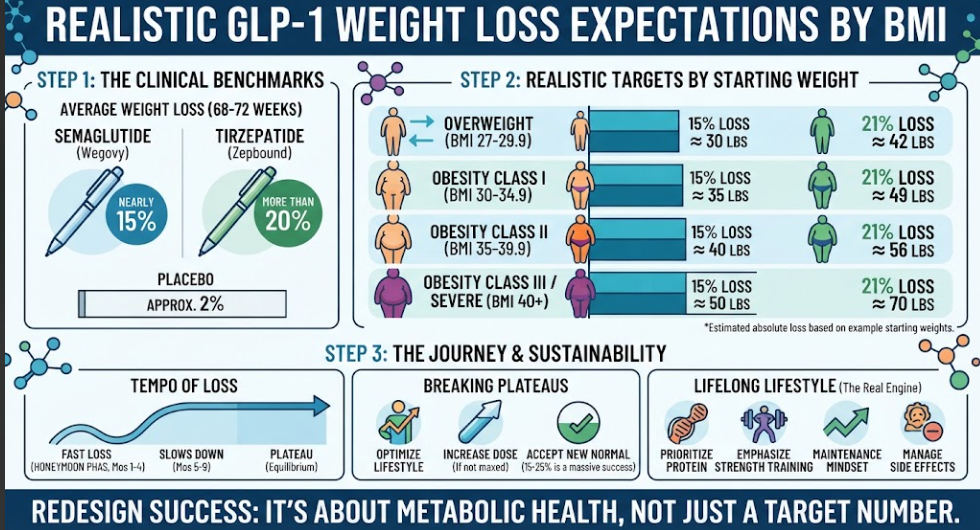
- The Headline Result: After sixty-eight weeks, participants on two point four milligrams of semaglutide lost an average of nearly fifteen percent of their body weight.
- The Placebo Group: The group receiving the lifestyle intervention plus a placebo injection lost only approximately two percent.
- The Diabesity Study (STEP two): This trial focused specifically on adults with type two diabetes.
- The Result: After sixty-eight weeks, participants on two point four milligrams of semaglutide lost an average of almost ten percent of their body weight. This lower percentage (compared to STEP one) is significant, as metabolic dysfunction associated with diabetes often makes weight loss more resistant.
The Tirzepatide (Zepbound) Trials: The SURMOUNT Program
Tirzepatide is a dual agonist (GIP and GLP-1), which preclinical data suggested might be more potent.
- SURMOUNT-one Trial: This was the primary study for Zepbound (tirzepatide). It mirrored the STEP one inclusion criteria (non-diabetic adults with obesity or overweight).
- The Headline Result: After seventy-two weeks, participants on the highest dose (fifteen milligrams) lost an average of more than twenty percent of their body weight.
- The Lower Doses: Those on five milligrams lost approximately fifteen percent, and those on ten milligrams lost nearly twenty percent. This establishes a clear, dose-dependent relationship.
- The Surgical Comparison: This average reduction approaches the results typically seen one to three years post-gastric bypass surgery, which usually ranges from twenty-five to thirty-five percent total weight loss.
Critical Nuance – “Average” Weight Loss vs. Distribution
While the averages (nearly fifteen percent for semaglutide, more than twenty percent for tirzepatide) are impressive, they obscure the most important part of the data: the distribution of individual responses. “Average” implies that everyone loses that amount, which is statistically false.
GLP-1 therapy is not a uniform tool; it is a highly individual response curve.
The Reality of the Bell Curve
Imagine the results plotted on a standard bell curve. While the peak (the mean) sits at nearly fifteen or more than twenty percent, the curve itself is wide.
- The Super-Responders (The Tail on the Right): In the SURMOUNT-one trial, more than a third of participants taking the highest dose of tirzepatide lost twenty-five percent or more of their body weight. For a two-hundred-fifty-pound person, that is a loss of sixty-two and a half pounds or more.
- The Modest Responders (The Tail on the Left): Conversely, a smaller percentage of the trial population experienced a much less robust response. Some individuals in the trials (despite adhering to the protocol) lost less than five percent of their total body weight. While the drug is effective for the majority, it is not effective for everyone.
Defining “Clinically Significant” Weight Loss
In obesity medicine, a five percent total body weight loss is the universally accepted benchmark for “clinically significant.” This level of reduction is sufficient to trigger measurable improvements in cardiometabolic health—including lower blood pressure, improved insulin sensitivity, reduced liver fat, and decreased joint pain.
Even the “modest” responders in the GLP-1 trials overwhelmingly achieved this five percent threshold. Therefore, a realistic expectation is not just hitting the average, but securing a durable, health-altering reduction of at least five to ten percent.
Realistic Expectations by Starting BMI Category
This is the core of our analysis. A fifteen percent weight loss represents a vastly different absolute number of pounds depending on the starting weight. We must segment expectations by BMI category to provide a truly realistic picture.
Note: All percentage-based projections below are based on the average for Semaglutide (Wegovy) and the average for Tirzepatide (Zepbound) at sixty-eight to seventy-two weeks. Individual results will vary significantly.
Overweight (BMI twenty-seven to twenty-nine point nine)
This category includes individuals who may have twenty to forty pounds to lose to reach a “normal” BMI (though BMI is an imperfect metric). They are often seeking treatment to prevent the progression to obesity or to manage early-stage comorbidities.
- Clinical Rationale: GLP-ones are highly effective in this group, as the metabolic resistance is often less severe than in established obesity.
- The Two-Hundred-Pound Patient Profile: Let’s model a five-foot-nine-inch patient starting at two hundred and two pounds (BMI twenty-nine point eight).
- Semaglutide (Average): A realistic target would be a loss of approximately thirty pounds, bringing them to one hundred and seventy-two pounds (BMI twenty-five point four).
- Tirzepatide (Average): A realistic target would be a loss of approximately forty-two pounds, bringing them to one hundred and sixty pounds (BMI twenty-three point six).
- Realistic Takeaway: For patients in this category, achieving a “normal” BMI is highly realistic. The journey may be faster, and the final percentage loss may even exceed the average due to less metabolic adaptation.
Obesity Class one (BMI thirty to thirty-four point nine)
This is the most common entry point for GLP-one therapy. These patients typically have forty to seventy pounds to lose.
- The Two-Hundred-Thirty-Pound Patient Profile: Let’s model a five-foot-seven-inch patient starting at two hundred and thirty-two pounds (BMI thirty-six point three).
- Semaglutide (Average): A realistic target would be a loss of approximately thirty-five pounds, bringing them to one hundred and ninety-seven pounds (BMI thirty point eight).
- Tirzepatide (Average): A realistic target would be a loss of approximately forty-nine pounds, bringing them to one hundred and eighty-three pounds (BMI twenty-eight point six).
- Realistic Takeaway: For this patient, moving from “Class one Obesity” to the cusp of “Overweight” is a powerful and highly realistic outcome. This shift dramatically reduces health risks. While crossing into the “normal” BMI range is possible (especially with Tirzepatide or strong lifestyle changes), it should be viewed as a “stretch goal” rather than a baseline expectation.
Obesity Class two (BMI thirty-five to thirty-nine point nine)
This group carries a significantly higher risk of cardiovascular disease, type two diabetes, and severe osteoarthritis. They are often looking to lose seventy to one hundred-plus pounds.
- The Two-Hundred-Sixty-Five-Pound Patient Profile: Let’s model a five-foot-ten-inch patient starting at two hundred and sixty-eight pounds (BMI thirty-eight point four).
- Semaglutide (Average): A realistic target would be a loss of approximately forty pounds, bringing them to two hundred and twenty-eight pounds (BMI thirty-two point seven).
- Tirzepatide (Average): A realistic target would be a loss of approximately fifty-six pounds, bringing them to two hundred and twelve pounds (BMI thirty point four).
- Realistic Takeaway: For these patients, the average loss results in a massive absolute reduction (forty to fifty-six pounds) that is profoundly life-altering. However, even after this success, they will likely remain in the “Overweight” or “Class one Obesity” categories. This highlights that GLP-one therapy is often part of a continuum of care, not a single fix.
Obesity Class three / Severe Obesity (BMI greater than or equal to forty)
This group faces the greatest metabolic challenges and often has one hundred-plus pounds to lose. They are the population most frequently compared to surgical candidates.
- The Three-Hundred-Thirty-Pound Patient Profile: Let’s model a five-foot-nine-inch patient starting at three hundred and thirty-five pounds (BMI forty-nine point five).
- Semaglutide (Average): A realistic target would be a loss of approximately fifty pounds, bringing them to two hundred and eighty-five pounds (BMI forty-two point one).
- Tirzepatide (Average): A realistic target would be a loss of approximately seventy pounds, bringing them to two hundred and sixty-five pounds (BMI thirty-nine point one).
- Realistic Takeaway: The absolute weight loss (fifty to seventy-plus pounds) is staggering and will lead to massive improvements in mobility, sleep apnea, and blood sugar control. This is a monumental success by any clinical metric. Yet, these patients will still be classified as having obesity. For this group, GLP-ones are often the first step toward achieving metabolic health sufficient for other interventions, or a long-term management strategy to prevent further weight gain.
The Weight Loss Curve – Why Results Slow Down
A critical part of managing expectations is understanding the tempo of weight loss on a GLP-1. It is not a straight line down.
The Honeymoon Phase (Months one through four)
Weight loss is typically most rapid during the first three to four months. This is due to several factors: one. Caloric Deficit: The drug’s effect on appetite suppression is novel to the body, resulting in the largest initial drop in caloric intake. two. Water Weight: The initial weight loss often includes a significant amount of water and glycogen (stored carbohydrates), especially if the patient is also reducing carbohydrate intake.
The Deceleration Phase (Months five through nine)
Between months five and nine, the rate of weight loss invariably slows down. This is a normal physiological response, not a failure of the medication. one. Metabolic Adaptation: As the body gets smaller, its Basal Metabolic Rate (BMR) decreases. It requires fewer calories to maintain the new, lower weight.
To continue losing, the caloric deficit must be further increased. two. Hormonal Counter-Regulation: The body possesses powerful hormonal mechanisms to defend its “set point” (the highest weight it has historically maintained). As weight is lost, the body increases hunger hormones (like ghrelin) and decreases satiety hormones (like leptin) in a frantic attempt to regain the lost mass.
The GLP-one medication is fighting against this tide, but it cannot eliminate it entirely. three. Lean Mass Loss: A portion of any weight loss is lean muscle mass. The loss of even a small amount of metabolically active muscle further slows the BMR. (This underscores the critical need for resistance training).
The Ultimate Plateau – Finding the New Equilibrium
Every weight loss journey on a GLP-1 hits a “plateau”—a point where the scale stops moving for a sustained period (typically three to four weeks).
Why Plateaus Happen on GLP-ones
When you start a GLP-one, you establish a new baseline caloric intake. Your body adapts to this intake over six to nine months, and your weight stabilizes at a new equilibrium. You are no longer in a caloric deficit; you are in caloric maintenance at a lower weight.
The Timing of the Plateau
Clinical trial data show that weight loss on semaglutide (Wegovy) generally plateaus around week sixty. For tirzepatide (Zepbound), the plateau is reached around week seventy-two.
After this period, patients typically enter a maintenance phase. The medication is no longer actively causing weight loss; it is now acting as an anti-obesity maintenance drug, preventing the weight regain (the “rebound effect”) that occurs when the drug is stopped.
Strategies to Break a Plateau (Or Accept the New Normal)
If you hit a plateau before you have reached your personal goal, you have limited options: one. Optimize Lifestyle: The “easy” deficit from the drug’s initial effect is gone. You must now create a conscious deficit through meticulous tracking of intake and increased physical activity. This is where most patients fail. two. Increase Dose (If Not Maxed):
Your prescriber may titrate you to a higher dose (e.g., from one point zero milligrams to one point seven milligrams Ozempic, or ten milligrams to fifteen milligrams Mounjaro) to re-establish the necessary appetite suppression. three. Acceptance:
If you have been on the medication for over a year and have lost fifteen to twenty-five percent of your body weight, you have achieved a massive, statistically significant result. Pushing for further loss may be physiologically unsustainable and require a level of restriction that negatively impacts quality of life. For many, the plateau is the signal that they have successfully reached their body’s new, healthier equilibrium.
The Pillar of Success – Lifestyle Integration
The clinical trials are unequivocal: GLP-ones are not a substitute for lifestyle change. The fifteen and twenty-one percent averages in the trials were achieved with the explicit directive to patients to reduce caloric intake by five hundred calories per day and increase physical activity.
Patients who rely solely on the drug’s appetite suppression without intentionally changing their diet and exercise habits will inevitably fall into the “modest responder” category and regain the weight faster if the drug is ever stopped.
The Four Pillars of Lifestyle Integration
one. Prioritize Protein: This is non-negotiable. A high-protein diet is critical for two reasons: * Satiety: Protein is the most satiating macronutrient, working in synergy with the GLP-1 to reduce hunger. * Muscle Sparing: As discussed, rapid weight loss causes muscle loss.
A high-protein intake, combined with resistance training, is the only way to mitigate this. two. Emphasize Strength Training: You cannot just do cardio. Resistance training (lifting weights, bodyweight exercises) is essential to signal to the body that muscle mass is required, forcing it to burn fat instead. three.
Develop a Maintenance Mindset from Day Two: The “diet” ends when you stop taking the medication, because the metabolic condition of obesity will return. The habits you build early on (tracking macros, meal planning, scheduling workouts) are the habits you must maintain for life. four. Navigate Side Effects:
Gastrointestinal side effects (nausea, constipation, diarrhea) are common. A realistic expectation is that you will have to manage these, often through dietary adjustments (smaller meals, avoiding fatty/spicy foods, aggressive hydration). Patients who cannot manage the side effects are forced to discontinue the medication.
Conclusion: The New Paradigm of GLP-1 Weight Loss Success
Understanding realistic expectations on a GLP-1 requires abandoning the idea of a “target weight” derived from the outdated BMI charts. Instead, success must be redefined in the context of metabolic health and sustainable change.
one. A five- to ten percent total body weight loss is a massive success. It is sufficient to reverse pre-diabetes, lower blood pressure, and improve overall health. two. A fifteen to twenty-five percent loss is an extraordinary success. This places you in the top tier of trial responders and achieves results previously reserved for bariatric surgery. three. The medication’s active weight loss phase lasts about twelve to eighteen months. After this, the drug’s role shifts to chronic maintenance to prevent weight regain. four. Weight loss is not a linear path.
Expect rapid loss in the first few months, followed by a significant slowdown, and eventually, a plateau. five. Lifestyle is the engine of long-term success. The drug provides the metabolic opportunity, but your diet and exercise habits determine the final destination.
By internalizing these data-driven realities, patients can approach GLP-1 therapy not with the frantic hope of a quick fix, but with the grounded confidence of embarking on a challenging, long-term, and profoundly effective health journey.
Leave a Reply