The honest answer, before anything else: no legitimate provider puts GLP-1 medication in your hands the same day you apply. Anyone promising literally instant approval without a clinician actually reviewing your medical history is describing a regulatory red flag, not a service feature. What is genuinely possible in 2026 is same-day or next-day clinical approval, with medication arriving within a matter of days rather than weeks.
Understanding the real mechanics behind that timeline – and why it varies so much between providers – is the difference between realistic expectations and frustration.
The real timeline, stage by stage
The chart above shows typical clinician approval windows across several of the faster-moving providers, based on their own published timelines as of 2026. The pattern across the industry breaks into a few distinct stages.
First comes the intake questionnaire, which most platforms complete in well under an hour — a detailed medical history covering current conditions, medications, prior weight-loss attempts, and relevant contraindications like a personal or family history of certain thyroid cancers. Second comes clinician review, which occurs asynchronously on most fast-moving platforms rather than via a live video call, and typically takes 24 to 72 hours, depending on the provider and current patient volume.
Third comes prescription approval and routing to a pharmacy, which for compounded medications usually means a licensed 503A compounding pharmacy, and for brand-name medications means either direct manufacturer fulfillment or a standard retail pharmacy pending insurance processing. Finally comes shipping, which for compounded medications from a 503A pharmacy is often free and expedited once the prescription is compounded.
End to end, from submitting your intake questionnaire to medication physically arriving, two to four days is a realistic range for cash-pay compounded medication through one of the faster platforms. Brand-name medication routed through insurance follows a meaningfully different and less predictable timeline, discussed further below.

Why “instant” claims are a warning sign, not a convenience
The entire legal structure of prescribing in the United States requires a licensed clinician to actually evaluate a patient before writing a prescription. That evaluation can be asynchronous rather than a live call, and it can happen quickly, but it has to happen. A platform advertising instant or automatic approval with no meaningful clinical review is describing something that either isn’t real prescribing or is cutting a corner that should concern you far more than it saves you time. This distinction matters especially in the GLP-1 space, where contraindications are genuinely important to screen for before someone starts treatment.
What actually determines your personal timeline
Several concrete factors move your individual timeline faster or slower than the industry averages described above.
State licensing plays a real role, since telehealth prescribers must be licensed in the state where the patient is physically located at the time of the visit. A platform with clinicians licensed in fewer states may simply be unable to serve you quickly, or at all, depending on where you live – and this is worth checking before you spend time on an intake questionnaire, not after. Cash-pay versus insurance-routed prescriptions is probably the single biggest factor: paying directly, whether for a brand-name manufacturer program or a compounded medication, removes the prior authorization step entirely and is almost always faster.
Compounded versus brand-name medication also matters significantly, covered in detail in the next section. And whether a platform requires baseline lab work before prescribing adds real time — sometimes days, depending on how quickly you can get labs drawn locally — though it also reflects a more clinically thorough model, which is a genuine tradeoff rather than a pure downside.
Platform-specific operational capacity matters more than most people expect, too. A telehealth company scaling rapidly can see its own review times stretch during periods of high demand, even if its published timeline hasn’t changed. Checking recent patient reviews for mentions of actual wait times, rather than relying solely on a platform’s marketing copy, often gives a more accurate current picture than the official numbers alone.
Compounded versus brand-name: the speed tradeoff, and why it changed in 2026
This is one of the more significant shifts in the industry this year, and it directly affects how fast different platforms can move. The FDA removed semaglutide from its official drug shortage list on February 21, 2025, and mass 503B compounding from the bulks list ended by May 22, 2025.
Patient-specific 503A compounding remains legal under federal law, and several platforms, including Mochi Health, Henry Meds, and Remedy Meds, continued offering it into mid-2026. But the regulatory ground has kept shifting: an FDA proposal from April 30, 2026 seeks to exclude semaglutide, tirzepatide, and liraglutide from the 503B bulks list entirely, with a public comment period that ran through late June 2026.
Partly in response to this shifting landscape, some major platforms changed their model entirely. Hims and Hers settled with Novo Nordisk in March 2026 and exited compounded semaglutide for new patients, pivoting toward brand-name cash-pay options instead. Sequence, operated by WeightWatchers Clinic, stopped offering compounded GLP-1s back in May 2025 and now offers brand-name medication exclusively. Ro and Teladoc Health have never offered compounded GLP-1s to consumers at all, focusing instead on brand-name access through insurance and manufacturer programs.
Why this matters for speed specifically: compounded medication through a platform with an established 503A pharmacy relationship tends to move faster end-to-end, since it sidesteps insurance prior authorization entirely.
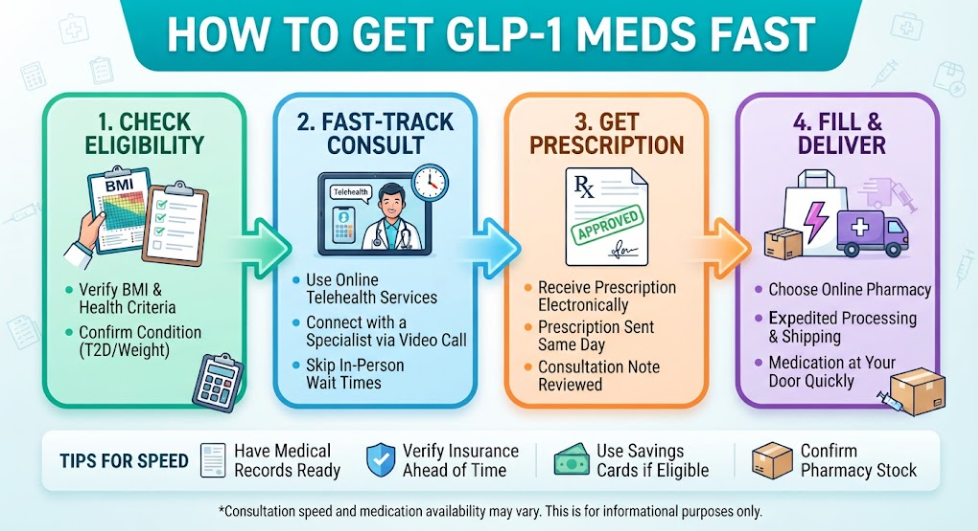
Brand-name medication can sometimes be just as fast if you’re paying cash through a manufacturer direct program, but becomes considerably slower and less predictable the moment insurance and prior authorization enter the picture.
Insurance and prior authorization: the real bottleneck
If you have commercial insurance and want brand-name Ozempic, Wegovy, Mounjaro, or Zepbound, cost usually isn’t the bottleneck — prior authorization is. Platforms with a dedicated prior authorization team, notably Ro, Found, WeightWatchers Clinic, and LifeMD, are generally able to close approvals within days rather than weeks.
Platforms without that specific operational capability tend to either send a denial after the first week or steer you toward their cash-pay compounded alternative regardless of what you originally signed up for.
If speed matters more to you than using insurance, cash-pay routes consistently outperform the insurance path timeline-wise, even when insurance would ultimately make the medication cheaper. This is a genuine tradeoff between speed and cost that’s worth thinking through deliberately rather than defaulting to whichever option a platform’s marketing emphasizes.
It’s also worth understanding what “prior authorization” actually involves, since the term gets thrown around without much explanation. Your insurer requires documentation, usually from your prescriber, showing that you meet specific clinical criteria — commonly a BMI threshold, sometimes combined with a related health condition like high blood pressure or elevated cholesterol.
Platforms with dedicated PA teams have staff whose entire job is assembling and submitting this documentation correctly the first time, which is precisely why they close approvals faster than platforms treating prior authorization as an afterthought. A denied prior authorization can often be appealed, but that adds real time to an already insurance-dependent timeline, which is one more reason cash-pay routes tend to move faster in practice.
Five GLP-1 telehealth companies compared: speed and cost
The chart above shows starting monthly pricing for four of these five companies as of 2026; Ro is described separately below since its cost depends fundamentally on your specific insurance coverage rather than a single flat number.
| Provider | Best known for | Starting price | Speed profile |
|---|---|---|---|
| Hims & Hers | Broad name recognition, familiar app, brand-name cash-pay | From $149/month | Fast; async review typically within 24-48 hours |
| Ro (Ro Body) | Insurance and prior authorization support, partners with both Novo Nordisk and Eli Lilly | Varies by insurance plan | Fast for cash-pay; days-long PA process for insurance-routed prescriptions |
| LifeMD | Publicly traded (Nasdaq: LFMD), broad menu including the Wegovy pill, strong insurance partnership with Novo Nordisk | From $129/month membership; Wegovy pill from $149/month cash-pay | Fast for cash-pay; dedicated PA team for insurance route |
| Mochi Health | Low-cost cash-pay compounded semaglutide, continues 503A compounding | From $99/month medication ($178/month all-in with membership) | Among the fastest; 24-48 hour typical approval |
| Sequence (WeightWatchers Clinic) | Behavioral coaching bundled with brand-name medication, cheapest path with commercial insurance | $74/month membership (intro pricing as low as $25/month for three months) plus $0-50 drug copay with savings card | Brand-name only since May 2025; speed depends on insurance PA timeline |
Hims and Hers built their reputation on low-friction onboarding and broad availability, though weight loss is just one of several product lines the platform manages, and pricing tends to run somewhat higher than compounded-focused competitors for equivalent treatment.
Ro stands out specifically for insurance navigation – if prior authorization is your biggest obstacle rather than raw speed, a platform with a dedicated PA team like Ro’s is often worth more than a faster but insurance-blind alternative, and Ro’s ability to route between both Novo Nordisk and Eli Lilly products gives it more flexibility than single-manufacturer platforms when one drug is covered and another isn’t. LifeMD has built one of the broadest brand-name menus in the space and is publicly traded, which some patients find reassuring from a stability standpoint; its early 2026 expansion to offer the Wegovy pill specifically reflects a broader industry shift toward oral GLP-1 options that don’t require self-injection.
Mochi Health remains one of the most consistently affordable cash-pay compounded options while continuing to offer some of the fastest approval windows in the industry, making it a natural fit for someone prioritizing both cost and speed over brand-name access.
Sequence’s behavioral-coaching-plus-medication model appeals to people who want structured support alongside the prescription itself, though it no longer offers a compounded fallback if insurance doesn’t come through, which is worth knowing upfront rather than discovering after a denial.
How to realistically speed up your own timeline
A few concrete choices genuinely move your personal timeline faster, separate from which platform you choose. Completing your intake questionnaire thoroughly and honestly the first time avoids delays caused by a clinician needing to follow up for missing information. Choosing a cash-pay path, whether compounded or a manufacturer direct brand-name program, sidesteps the prior authorization bottleneck entirely.
Confirming your state is fully served by a platform’s clinician network before signing up avoids discovering a licensing gap partway through the process. And being upfront about your full medical history from the start, rather than leaving out something you’re unsure is relevant, prevents a slower secondary review that a red flag in your file would otherwise trigger.
Frequently asked questions (FAQs)
Can I really get approved the same day I apply? For several platforms, yes — clinical approval within twenty-four to forty-eight hours is realistic for straightforward cases through cash-pay compounded or manufacturer direct programs, though medication in hand still takes a few additional days for shipping.
Why do some platforms take so much longer than others? Differences usually come down to whether you’re going through insurance prior authorization versus paying cash, whether the platform requires baseline labs, and how large and available their clinician network currently is.
Is a video call required, or just a questionnaire? Most fast-moving platforms use asynchronous questionnaire-based review rather than a live video visit, though some platforms or specific state requirements do mandate a video component.
Does choosing compounded medication over brand-name really make things faster? Generally yes, primarily because it avoids insurance prior authorization, though the regulatory landscape around compounding has been shifting throughout 2026 and availability varies by platform.
What’s the single biggest bottleneck if I want to use my insurance? Prior authorization, not cost. Platforms with a dedicated PA team close approvals meaningfully faster than platforms without that specific capability.
Should I be suspicious of a platform promising instant, no-review approval? Yes. Legitimate prescribing legally requires a licensed clinician to evaluate you first, and any platform skipping that step is not operating within normal prescribing standards.
Do lab requirements always slow things down? They add time, sometimes several days depending on how quickly you can get labs drawn locally, but they also reflect a more clinically thorough approach that some patients specifically prefer.
Can I switch platforms if my current one is too slow? Generally yes, though switching typically means starting the intake and review process over with the new platform rather than transferring your existing approval.
Does a faster approval mean lower quality care? Not necessarily, but it’s worth specifically asking any fast platform what their review actually involves, since speed and thoroughness aren’t inherently opposed but can be in tension depending on how a given platform operates.
How much does state licensing actually limit my options? It can meaningfully narrow your choices, since a platform’s clinicians must be licensed in your specific state; checking this before signing up prevents wasted time discovering it partway through intake.
The Bottom Line on How Fast You Can Get GLP-1 Meds
Same-day medication in hand isn’t realistic anywhere, and any platform claiming otherwise deserves real skepticism. Same-day or next-day clinical approval, followed by medication arriving within a few days, is genuinely achievable through several established platforms as of 2026, particularly for cash-pay compounded or manufacturer direct brand-name programs.
The fastest path for you specifically depends on whether you’re prioritizing raw speed over insurance savings, whether your state is well served by a given platform’s clinician network, and whether you’re comfortable with an asynchronous review process rather than a live visit.
Understanding these mechanics before you apply is what turns a frustrating guessing game into a realistic, plannable timeline – and in a field this fast-moving, where regulatory rules and individual platform policies keep shifting throughout the year, that understanding is worth revisiting periodically rather than treating as settled once and for all.
———————————–
Sources
Meto. “GLP-1 Telehealth Provider Comparison 2026.” https://meto.co/blog/glp-1-telehealth-provider-comparison
Trimi Health. “GLP-1 Same-Day Prescription: Which Providers Are Fastest?” https://trytrimi.com/blog/glp1-same-day-prescription
U.S. News & World Report. “GLP-1 Provider Comparison for Weight Loss: Cost, Insurance Support & Medication Options (2026).” https://health.usnews.com/best-diet/medication/top-glp-1-weight-loss-medication-providers
U.S. News & World Report. “Best GLP-1 Telehealth Platforms 2026-2027.” https://health.usnews.com/best-diet/medication/best-glp-1-telehealth-companies
Klarity. “Best Online GLP-1 Weight Loss Programs 2026.” https://www.helloklarity.com/post/top-8-online-weight-loss-programs-using-glp-1s/
Trimi Health. “Best Telehealth Weight Loss Providers 2026: 11 Ranked.” https://trytrimi.com/blog/best-telehealth-providers-ranked-2026
Leave a Reply