

If you’ve spent any time researching weight loss medications, you’ve likely run into two terms that seem to be used interchangeably but aren’t quite the same thing: GLP-1 and tirzepatide. Both are peptide-based medications that have transformed the medical approach to weight management, and both work by mimicking hormones your body already produces. But they aren’t identical, and understanding the difference matters if you’re trying to figure out which conversation to have with your doctor. This guide breaks down how each class works, where they overlap, where they diverge, and what factors typically influence which one a prescriber might recommend.
Starting With the Basics: What Is a Peptide Medication?
Peptides are short chains of amino acids — the building blocks of proteins. Your body uses peptides constantly as signaling molecules, including hormones that regulate hunger, digestion, and blood sugar. Peptide medications are designed to mimic these natural signals, essentially “speaking the same language” your body already understands, but in a more sustained and controlled way than your natural hormones typically provide.
The weight loss medications getting the most attention right now — semaglutide and tirzepatide — are both peptide-based, and both were originally developed to manage type 2 diabetes before their weight loss effects led to dedicated approval for chronic weight management.
What Is GLP-1?
GLP-1 stands for glucagon-like peptide-1, a hormone naturally produced in your gut after you eat. It’s part of a class of hormones called incretins, which help regulate blood sugar and appetite in response to food intake.
GLP-1 receptor agonist medications — the most well-known being semaglutide (marketed as Ozempic for diabetes and Wegovy for weight management) — work by binding to and activating GLP-1 receptors throughout the body, amplifying effects your own GLP-1 already produces, but in a more sustained way since these medications are engineered to resist rapid breakdown.
How GLP-1 Medications Work
GLP-1 receptor agonists act on several systems simultaneously:
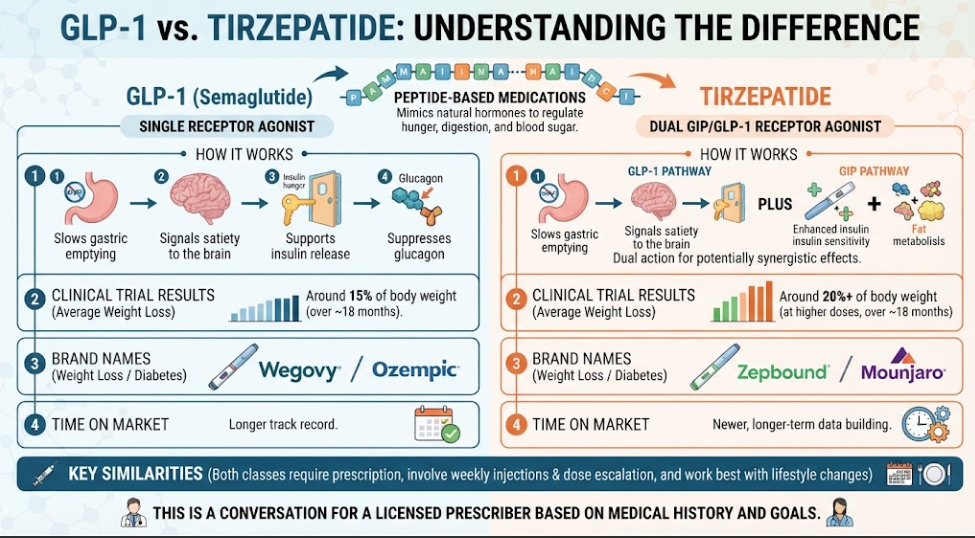
- Slowing gastric emptying — food stays in the stomach longer, extending the feeling of fullness after a meal
- Signaling satiety to the brain — GLP-1 receptors in appetite-regulating regions of the brain reduce hunger signals and cravings
- Supporting insulin release — in response to elevated blood sugar, which helps regulate glucose levels
- Suppressing glucagon — a hormone that raises blood sugar, further supporting glucose control
The net effect for weight management is a meaningful reduction in appetite and calorie intake, driven by biology rather than willpower alone. Clinical trials of semaglutide for weight management have shown average weight loss in the range of 15% of body weight over roughly a year and a half of treatment, though individual results vary considerably based on dose, duration, and lifestyle factors.
What Is Tirzepatide?
Tirzepatide (marketed as Mounjaro for diabetes and Zepbound for weight management) takes the GLP-1 mechanism and adds a second one. It’s classified as a dual GIP/GLP-1 receptor agonist, meaning it activates both the GLP-1 receptor described above and the GIP (glucose-dependent insulinotropic polypeptide) receptor.
How GIP Adds to the Picture
GIP is another incretin hormone, released from the gut in response to eating. On its own, GIP’s role in weight management is less straightforward than GLP-1’s — early research on GIP alone produced mixed results. But when combined with GLP-1 activation in a single molecule, the two appear to work synergistically, producing effects that are generally stronger than GLP-1 activation alone. The leading theories for why include:
- Enhanced insulin sensitivity — GIP receptor activation appears to improve how effectively the body uses insulin, complementing GLP-1’s effects on blood sugar
- Additional appetite suppression — the dual mechanism appears to produce a more pronounced reduction in food intake than single-receptor activation
- Possible effects on fat metabolism — some research suggests GIP receptor activation may influence how the body processes and stores fat, though this area is still being studied
In clinical trials, tirzepatide has produced average weight loss in the range of 20% of body weight or more at higher doses over roughly 18 months — meaningfully higher than what’s typically seen with semaglutide, though direct head-to-head comparisons are still a developing area of research and individual response varies widely.
Side-by-Side: Key Similarities
Before getting into the differences, it’s worth being clear about what these medications share, since the similarities are substantial:
- Both are injectable, typically administered on a weekly schedule
- Both require gradual dose escalation, starting low and increasing over weeks to months to reduce side effects
- Both cause similar side effects, primarily gastrointestinal — nausea, constipation, diarrhea, and reduced appetite, especially during the early weeks or after a dose increase
- Both require the same medical precautions — neither is recommended for people with a personal or family history of certain thyroid cancers, MEN 2 syndrome, or a history of pancreatitis
- Both work best paired with lifestyle changes — adequate protein intake and resistance training to preserve muscle mass, and structured eating patterns to manage the reduced appetite they produce
- Both require prescription and medical supervision — neither is something to source or dose without a licensed provider involved
Key Differences at a Glance
| Factor | GLP-1 (Semaglutide) | Dual GIP/GLP-1 (Tirzepatide) |
| Receptors targeted | GLP-1 only | GLP-1 and GIP |
| Brand names (weight loss) | Wegovy | Zepbound |
| Brand names (diabetes) | Ozempic | Mounjaro |
| Typical average weight loss in trials | Around 15% of body weight | Around 20%+ of body weight at higher doses |
| Time on market | Longer track record | Newer, still building long-term data |
| Administration | Weekly injection | Weekly injection |
Which One Might Be Recommended?
This is genuinely a decision for a licensed prescriber to make with you, based on your full medical history, but a few general factors tend to come up in that conversation:
Existing health conditions. Someone with type 2 diabetes and significant insulin resistance may be a strong candidate for tirzepatide specifically because of its additional effect on insulin sensitivity through the GIP pathway. A prescriber will weigh your metabolic profile heavily in this decision.
Weight loss goals and starting point. Because tirzepatide has shown somewhat greater average weight loss in trials, it’s sometimes considered for patients with a higher BMI or more significant weight loss goals — though this isn’t a hard rule, and semaglutide remains highly effective for many people.
Side effect tolerance. Some patients tolerate one medication better than the other, and this often isn’t predictable in advance. It’s common for a prescriber to start with one option and switch if side effects are difficult to manage or if progress plateaus.
Track record and familiarity. Semaglutide has been used in a weight-management context for longer, which means there’s a somewhat larger body of long-term data and more prescriber experience with it. Tirzepatide is newer to this specific use, though its underlying safety profile has been studied extensively in its diabetes indication.
Insurance and cost considerations. Coverage, formulary status, and out-of-pocket cost differ by insurer and can meaningfully influence which medication is realistic for a given patient — this is worth discussing directly with your provider and insurance plan.
None of these factors work in isolation, and a good prescriber will walk through your specific situation rather than defaulting to whichever medication is newest or most talked about.
What the Process Looks Like Either Way
Regardless of which medication ends up being the right fit, the process of starting treatment follows a similar structure:
- Medical evaluation — a full history, physical exam, and lab work (typically including metabolic panel, HbA1c, thyroid function, and lipid panel) to confirm candidacy and rule out contraindications.
- Gradual dose titration — both medications start at a low dose and increase incrementally over weeks or months, a schedule your prescriber manages based on your response and side effects.
- Regular follow-up — periodic check-ins to monitor progress, adjust dosing if needed, and review any side effects or new symptoms.
- Lifestyle integration — nutrition guidance (particularly protein intake) and movement, especially resistance training, to support muscle preservation as weight decreases.
- Long-term planning — a conversation, usually once you’re near your goal, about maintenance dosing and how to sustain results over time.
Common Misconceptions Worth Clearing Up
“Tirzepatide is just a stronger version of semaglutide.” Not exactly. While it does tend to produce greater average weight loss in trials, the mechanism is genuinely different — it’s not simply a higher dose of the same drug, but a molecule that engages an additional hormone pathway.
“These are new, unproven drugs.” The individual components have a long research history — GLP-1 receptor agonists have been used in diabetes care since the mid-2000s. What’s newer is specifically their approval and widespread use for weight management, which is a more recent development, along with tirzepatide’s dual-mechanism approach.
“Whichever produces more weight loss in trials is the better choice for everyone.” Average trial results describe a population, not an individual. Personal response, tolerability, health history, and cost all factor into which medication is genuinely the better fit for a specific person.
“You can decide which one you want and just order it online.” Both medications are prescription-only for good reason — appropriate use depends on an individualized medical evaluation, and dosing decisions need to be made and adjusted by a licensed provider based on how you respond over time.
The Bottom Line
Semaglutide (GLP-1) and tirzepatide (dual GIP/GLP-1) are both effective, evidence-backed options for medical weight management, and they share far more in common than they differ on — both are injectable, both require gradual titration, both come with similar side effect profiles, and both work best as part of a broader program that includes nutrition and activity changes, not as standalone fixes.
The meaningful difference is mechanism: tirzepatide’s addition of the GIP pathway alongside GLP-1 appears to produce somewhat greater average results in clinical trials, but “greater on average” doesn’t automatically mean “right for you.” The best path forward is a conversation with a licensed prescriber who can review your health history, lab work, and goals, and help you choose the option — and the dosing plan — that fits your specific situation. If you’re ready to explore whether either of these treatments might be right for you, the right next step is a medical evaluation, not a decision made from a comparison chart alone.